
By Qiu Ziyu, Harvard University
Throughout the Qing dynasty, reign names, along with other so-called “grand titles” (Ch. hongcheng 鴻稱; Ma. amba tukiyen de kadalara bithe), existed in both Chinese and Manchu forms. The selection of these grand titles—complimentary epithets typically bestowed upon emperors, empresses, imperial consorts, princes and princesses, ministers, etc.—followed a formalized procedure, with the Grand Secretariat proposing several possible titles accompanied by explanatory notes and requesting the emperor to make the final decision. But how exactly were these titles developed? What was the origin of the explanatory notes provided by the Grand Secretaries? Moreover, how were the Manchu equivalents created for grand titles that were originally in Chinese?
An archival document produced in the 14th year of Jiaqing’s reign (1809) by the office responsible for editing the Collected Statutes provides a window into these questions:
The Bureau of the Collected Statutes (Ch. Huidian guan 會典館) writes to consult: Previously our bureau has asked [your office] to check if the book Hongcheng tongyong 鴻稱通用 was made under the imperial order of Emperor Gaozong or earlier than the Qianlong reign. Our bureau has been long waiting for the answer, which has yet to come. Your office should at once verify the answer [and report]. Consult (to the right) the Office of Codes and Records (Ch. dianji ting 典籍聽).
Here we learn of the existence of a reference source known as Hongcheng tongyong (“Index of Grand Titles”), which provided proper and standardized explanations of Qing grand titles. The index, as speculated by officials of the Bureau of the Collected Statutes, was perhaps published during the Qianlong reign, or even earlier. Previous studies of Qing imperial rituals have also noted that the Collected Statutes of the Great Qing 大清會典 referenced the use of Index of Grand Titles to standardize the meanings of grand titles.[1] However, as most versions of Hongcheng tongyong are no longer known to historians, existing research on Qing titles generally relies on imperial memorials that mention titles of living or deceased royals or excerpts from the Chinese version of Index of Grand Titles perserved in Han literati-officials’ biji 筆記.[2]
In this post, I examine one of the few extant versions of Index of Grand Titles available to scholars and analyze the Manchu translations used in the text, comparing them to other known Manchu translations of Qing grand titles. I also provide a complete list of the 172 Manchu-Han grand titles included in the presented Index of Grand Titles, along with their English translations, to serve as a reference for future research.
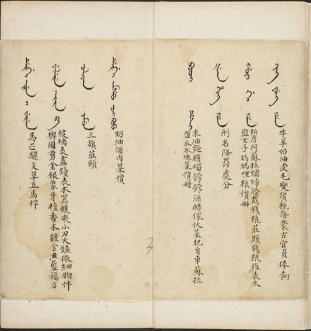
The Index of Grand Titles analyzed in this post is a part of a four-volume manuscript housed in the rare books collection of the Harvard-Yenching library. Titled Neiwufu dangce 內務府檔冊 (“Documents of the Imperial Household Department;” call number TMA 2748 4212), the manuscript is believed to be a work log of the Imperial Household Department during the Guangxu (1871–1908) era according to its content. It contains a variety of materials, including a bilingual table of errand distribution (names of people in charge in Manchu and content of errands in Chinese, see figure 1), a doggerel-like miscellany designed to helped officials and runners memorize rules and regulations, a catalog of ledgers and imperial memorials related to the Imperial Household Department, and, notably, a list of grand titles presented in both Manchu and Chinese. (Figure 1: A page of the Manchu-Han table of errand distribution in Neiwufu dangce 內務府檔冊, Page. seq 6, Harvard Yenching Library TMA 2748 4212.)
The section of Index of Grand Titles (Ma. amba tukiyen de uheri kadalara bithe) can be found in the first volume of this four-volume manuscript. Spanning fifteen pages, it contains a total of 172 titles used during the Qing dynasty. Notably, the index does not include explanatory notes for the listed words. Given its inclusion in an imperial work log, this index was likely intended to assist officials of the Imperial Household Department in quickly identifying the Manchu equivalents of Chinese grand titles for use in daily ceremonies, particularly during imperial sacrifices. The arrangement of the words appears to follow no discernible order, whether in the Chinese characters or their Manchu counterparts.
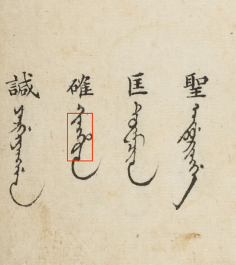
Looking into the text, scholars familiar with the Manchu language can identify multiple errors in the Manchu script within this index. It appears that the individual who drafted the manuscript either had a limited proficiency in the writing of the language or simply copied the text from an earlier source that was itself already full of mistakes. For instance, the Manchu translation of the Chinese word jie 介was wrote as hicen, while the correct word should be hican (meaning frugal). The drafter seems to have particular difficulty distinguishing between k/g/h and r/l/j/i. The first type of error—confusion between k/g/h—is commonly observed in the use of the Manchu language, but the second type of error is relatively rare.[3] For instance, as shown in Figure 2, under the Chinese character que 確, the drafter wrote kinghun. However, the correct Manchu word for “firm/unshakable” is kionggun. Similarly, henggitungga was used instead of the correct genggitungga (“illustrious”) for the translation of zhao 昭. Other examples include hosin instead of gosin (“mercy”) for ren 仁, hocisūn instead of gocishūn for qian 謙 (“modest”), and undu instead of kundun for yi 翼 (“supportive”). (Figure 2. A page of Index of Grand Titles with mistakes in the Manchu language marked.)
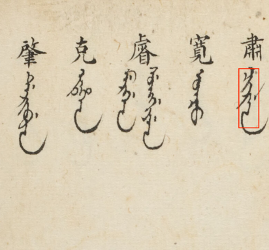
In addition to the confusion with k/g/h, the manuscript contains other types of errors. Some Manchu words are missing their initial characters. For instance, saikan (“beautiful”) is written as aikan, with the “s” omitted. On the final page of this section, the word ming (明)—genggiyen—appears twice in different columns. A distant hypothesis built on these mechanical errors, such as omitting the first letter, confusing similar graphemes, or repeating a certain word in writing might be that the manuscript is a copy of an earlier document rather than a newly drafted work, though more evidence is needed to support the argument.
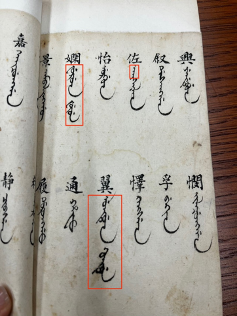
Another noteworthy discovery is that the Manchu translations of certain Chinese words in this manuscript differ from examples found in the early and high Qing periods. For instance, the Chinese title lü 履is translated as doronggo in this text, whereas the full Manchu title for the Lü Prince was more commonly written as hošoi dorolon cin wang.[4] Similarly, the title xian 嫻, once used by the second empress of Qianlong, is translated here as furun/fujun (“gracious”) rather than elehun (“composed”) as recorded in imperial memorials about the empress.[5] Additionally, the title ling 令, translated as mergen (“wise”) or giltukan (“refined”) during the Qianlong era, is rendered in this manuscript as mergen or saintu (“excellent”).[6] (Figure 3. A page of Index of Grand Titles. Three words marked with red are misspelled.)
This manuscript also showcases the flexibility of Manchu-Han translation when it comes to titles. Throughout the Qing dynasty, translations of grand titles from Chinese to Manchu were never strictly standardized but often adapted to specific contexts. For example, multiple Chinese words could share the same Manchu translation—duan 端, zhuang 莊, and zheng 正 were all rendered as tob (“straight”). Likewise, both shu 淑 and wan 婉 were translated as nemeyen (“tender, gentle”). Conversely, a single Chinese word could have more than one Manchu equivalent. For instance, the manuscript offers two translation for rui 睿: mergen (“wise”) and sunggiyen (“sagacious”). As noted earlier, the word ling 令 is given two interpretations: mergen (“wise”) and saintu (“good, excellent”). The word cheng 誠 appears twice in the manuscript, first translated as unenggi (“honest”); and then as yargiyangga (“true”).
The Harvard-Yenching version of Index of Grand Titles provides us a rare glimpse into how Manchu titles and Manchu-Han bilingualism were partially preserved in the late Qing court. From the document authored by the Bureau of the Collected Statutes during the Jiaqing era to this Index of Grand Titles section in a Guangxu work log, we can surmise that the Hongcheng tongyong compiled during the Qianlong era or earlier continued to circulate, be copied, and be used by court officials well into the last century of the dynasty. However, the original version must have disappeared amidst the millions of documents of the Qing court, to the point that officials during the Jiaqing era had to inquire about its origins. This error-laden version of the Index of Grand Titles may offer us a window into the complex status of Manchu in the late Qing court.
Appendix. 鴻稱通用 amba tukiyen de uheri kadalara bithe
All misspelled words are marked with an asterisk. Hu Zengyi’s New Manchu-Han Dictionary includes some grand titles (Ch. fengshi yongyu 封諡用語). Terms included in Hu’s dictionary are marked #XMH. All English translations are from Jerry Norman, A Comprehensive Manchu-English Dictionary (2013). Words marked with an exclamation mark ! are words that are not included in Norman’s dictionary but in Kawachi Yoshihiro 河内良弘, Manshūgo bungo bunten満州語文語文典 (2014).
“封諡等用處之整字” means “a term that cannot be broken down/modified and only used as grand titles.” Hu Zengyi used this category to mark a lot of words that we see in this chart, and I keep his expression.
| Chinese | Manchu Translation | English Translation of Manchu |
| 比 | ulhisu | sensitive, keen, clever |
| 原 | da | root, stock, base, source, origin |
| 太 | tai | transliteration from Chinese |
| 貞 | jekdun | chaste, pure, chastity, purity |
| 廉 | hanja | incorrupt, honest, clean, pure #XMH |
| 恕 | giljan | pardon, forgiveness |
| 介 | hicen*(hican) | frugal, abstemious, simple #XMH |
| 恬 | elehun | content, calm, tolerant, at ease, relaxed, composed #XMH |
| 慎 | olhoba | careful, attentive, cautious, circumspect #XMH |
| 襄 | faššangga | expending effort, meritorious, industrious |
| 益 | tusangga | beneficial, profitable #XMH |
| 慤 | hisengge*(hingsengge) | sincere, honest #XMH |
| 儀 | yongsu | ceremony, rite, custom, usage |
| 循 | julungga | docile, obedient #XMH |
| 撫 | bilun | pacification |
| 佑 | aisingga | bless |
| 崇 | ten | exalted, lofty, noble #XMH |
| 淑 | nemeyen | tender, gentle, graceful, docile, easygoing #XMH |
| 章 | eldembuhe | glorified, extoled |
| 成 | šengge | divine, prophetic, wonderful, magical |
| 安 | elhe | peace, calm, well-being, peaceful, healthy #XMH |
| 禮 | dorolon | rite, ceremony, propriety |
| 肅 | cirln* (ciran) | solemnity, seriousness |
| 和 | hūwaliyasun | harmony, concord, peace #XMH |
| 宽 | onco | broad, wide, generous |
| 誠 | unenggi | true, honest, genuine #XMH |
| 睿 | mergen/sunggiyen | outstanding, wise, worthy/sagacious, sensible #XMH |
| 聖 | enduringge | divine, holy, sacred |
| 克 | etehen | victory |
| 匡 | tuwamcin | circumspect, prudent #XMH |
| 肇 | deribun | beginning, cause |
| 確 | kinghun*(kionggun) | firm, unshakable #XMH |
| 節 | jalangga | chaste |
| 誠 | yargiyangga | true, honest, factual #XMH |
| 賢 | erdemungge | virtuous, moral, talented #XMH |
| 誾 | nairahūn | gentle, kind, warm, generous #XMH |
| 謐 | fingge | tranquil, peaceful, serene, resolute #XMH |
| 愉 | hebengge | obedient #XMH |
| 遜 | anashūn | flexible, yielding, modest, unassuming |
| 慧 | ulhisungge | clever, intelligent |
| 充 | tesun | sufficient, satisfactory #XMH |
| 齊 | teksin | even, equal, straight, well-proportioned, neatly arranged #XMH |
| 良 | nomhon | docile, quiet, tame, guileless, honest #XMH |
| 𡽪 | wengge | highly educated, cultured #XMH |
| 泰 | hafun | the eleventh hexagram of the Yijing |
| 慈 | jilan | compassion, pity, love |
| 昭 | henggitungga*(genggitungga) | illustrious, manifest |
| 理 | giyangga | reasonable, right, proper |
| 端 | tob | straight, upright, serious, right, just |
| 莊 | tob | straight, upright, serious, right, just #XMH |
| 烈 | lingge | a shining deed, a glorious deed #XMH |
| 順 | ijishūn | obedient, submissive, docile, filial #XMH |
| 溫 | nesuken | gentle, tender, mild |
| 信 | akdun | firm, strong, dependable, solid, sturdy |
| 哲 | sultungga | wise, sagacious #XMH |
| 神 | šengge | divine, prophetic, wonderful, magical |
| 隱 | aliyasungga | patient #XMH |
| 勇 | baturu | brave, hero #XMH |
| 興 | yendebun | a kind of verse in which natural objects are used to represent feelings |
| 憫 | jilacungga | compassionate, merciful #XMH |
| 敘 | dasangga | keeping order, having talent for government #XMH |
| 孚 | bekin | confidence, trust #XMH |
| 佐 | anisinlan* (aisilan) | help, aid, assistance |
| 懌 | keksen | gratification, satisfaction #XMH |
| 怡 | urgun | joy, felicity, happiness, auspicious sign, good portent #XMH |
| 翼 | undun* (kundun) | respectful #XMH |
| 嫻 | fujun*(furun) | refined |
| 通 | hafu | penetrating, going through, thorough, comprehensive, enlightened |
| 景 | ambalinggū | big and tall, stalwart, imposing, grand, great, dignified #XMH |
| 履 | doronggo | moral, honest, possessing proper principles |
| 宜 | acabungga | united, harmonized, adapted, appropriate, commensurate, corresponding |
| 粹 | dersen | pure, genuine, unmixed |
| 嘉 | saicungga | 嘉/封諡等用處之整字!#XMH |
| 静 | cibsen | quietness, stillness |
| 宣 | gehungge | 宣/ 封諡等用處之整字!#XMH |
| 憲 | temgetulehe | from temgetu, stamp, manifest |
| 穆 | cibsonggo | from yashu mingmu衙署名目(1890) |
| 敬 | ginggun | respect, honor, caution, respectful |
| 毅 | kiyangkiyan | having exceptional ability, intrepid, robust, powerful #XMH |
| 康 | nelhe | peaceful, healthy #XMH |
| 元 | ikengge | original, chief, great, large |
| 淵 | mumin | very deep, profound, unfathomable |
| 中 | dulimba | middle, center |
| 文 | šu | refinement, culture, learning, refined, elegant, educated |
| 哀 | usacungga | sorrowful, afflicted # XMH |
| 世 | ši | transliteration of Chinese |
| 翊 | wehiyen | assistance, protective spirit #XMH |
| 延 | aniyangga | pertaining to a certain year in the twelve-year cycle, aged |
| 達 | šuwefun | thorough realization, clear understanding |
| 壯 | etuhun | strong, powerful, vigorous |
| 湻 | bolmin | incorrupt, sincere |
| 雝 | yungge | harmonious, peaceful |
| 懋 | fulungga | grand, majestic #XMH |
| 婉 | nemgiyen | affectionate, gentle, tender |
| 穎 | susultungga | intelligent, highly gifted, outstanding #XMH |
| 誉 | algintu | famous person, celebrity #XMH |
| 協 | uhe | common, general, united, uniform, of one kind, joined together, communality, unity #XMH |
| 惇 | jingji | heavy, steady, firm, grave, ceremonious |
| 茂 | huwengge | luxuriant, abundant |
| 慶 | fengšengge | prosperous, fortunate #XMH |
| 恪 | gingguri*(gingguji) | respectful, chaste #XMH |
| 光 | uldengge | shining, lit up |
| 度 | fuliyangga | from fuliyambi to forgive, to pardon |
| 英 | fafungga | having legal force, legal, worthy of respect |
| 恭 | gungnecuke | respectful #XMH |
| 威 | horon | majesty, authority, awe, power #XMH |
| 定 | tokton | resolution, determination |
| 惠 | fulehun | favor, kindness, good deed, alms |
| 懿 | fujurungga | refined, elegant, graceful, sedate #XMH |
| 正 | tob | straight, upright, serious, right, just |
| 武 | horonggo | powerful, terrible, awe-inspiring, possessing great authority |
| 殤 | aldaraka | died young |
| 懷 | nasucungga | regrettable, pitiable |
| 道 | doro | doctrine, precept, morality, way, rule, ritual |
| 桓 | hongtu | 桓/封諡等用處之整字 !#XMH |
| 紹 | sirengge | from sirembi, string, line, thread, runner, tendril, creeper, fuse, vein, capillary |
| 果 | kengse | resolute, determined #XMH |
| 勉 | fafuri | energetic, diligent, brave, courageous #XMH |
| 潔 | gingge | clean, pure, honest, incorruptible |
| 豫 | erke | powerful, strong, bold #XMH |
| 密 | kimcikū | checker, examiner, thorough, exact, careful |
| 舒 | sulfa | at leisure, free, at ease, without cares #XMH |
| 瑩 | nilgiyangga | lustrous, brilliant, shining #XMH |
| 質 | gungmin | honest, sincere, fair |
| 恂 | boljonggo | conventional, determined by custom, customary #XMH |
| 厚 | jiramin | thick, generous, kind |
| 榮 | derengge | decorous, proper, noble, honored |
| 禧 | urgungga | blessed, fortunate, auspicious #XMH |
| 壽 | jalafungga | possessing long life, long-lived |
| 顯 | iletu | well-known, clear, out in the open, manifest, obvious, public #XMH |
| 思 | gūningga | full of ideas, reflective |
| 敏 | ulhisu | quick to grasp, sensitive, keen, clever |
| 儉 | malhūn | economical, frugal, seemingly, near but really far |
| 剛 | mangga | hard, difficult, expensive, strong, fierce, a strong man |
| 平 | necin | level, flat, even #XMH |
| 敦 | jirun* (jiramin) | thick, generous |
| 仁 | hosin* (gosin) | pity, mercy, love #XMH |
| 高 | dergi | top, above, over, upper, superior #XMH |
| 純 | gulu | simple, pure, unadulterated, unrefined, in a natural state #XMH |
| 聰 | sure | wise, intelligent, wisdom |
| 愍 | gosicungga | merciful, compassionate #XMH |
| 修 | dasartungga | pertaining to a reformer #XMH |
| 獻 | fengkin | 獻/封諡等用處之整字 !#XMH |
| 忠 | tondo | straight, upright, loyal, fair, accurate |
| 直 | sijirhūn | straight, not crooked, upright, honest |
| 睦 | hūwangga | on good terms with, in concord |
| 芳 | aikan* (saikan) | pretty, good-looking, beautiful |
| 忻 | ulguntu*(urguntu) | joyful, happy |
| 謹 | ginggulen | respect, attentiveness #XMH |
| 勤 | kicebe | diligent, assiduous, industrious, hardworking #XMH |
| 謙 | hocishūn* (gocishūn) | modest, humble |
| 恆 | tomohonggo | constant, persevering, determined, calm, composed #XMH |
| 令 | mergen/saintu | outstanding, wise, worthy, skilled, adept/good, excellent |
| 容 | baktan | capacity, contents |
| 熹 | hūturingga | possessing good fortune, fortunate #XMH |
| 琪 | fengšen | prosperity, good fortune #XMH |
| 寧 | nikton | at peace, peaceful #XMH |
| 熙 | taifin | peace, tranquility #XMH |
| 僖 | olhošon | cautious, careful, respectful #XMH |
| 簡 | kemungge | having measure, frugal, limited, measured, simple #XMH |
| 明 | genggiyen | bright, clear, enlightened, brilliant #XMH |
| 欽 | kobton | respect, reverence |
| 義 | jurgangga | honorable, loyal, upright, morally courageous, righteous |
| 靖 | necihiyen | peaceful, tranquil, serene #XMH |
| 裕 | elgiyen | prosperous, rich, plentiful, abundant #XMH |
| 德 | erdemu | virtue, moral conduct, talent, skill |
| 孝 | hiyoošungga | filial #XMH |
| 明 | genggiyen | bright, clear, enlightened, brilliant #XMH |
| 全 | gemungge | pertaining to the capital different meaning for titles #XMH |
| 頤 | urangga | sonorous, resonant |
| 佳 | giltungga | refined, talented |
| 玟 | gihungge* (gehungge) | 宣/封諡等用處之整字! #XMH |
[1] For instance, Wang Miansen 王勉森 mentioned that Hongcheng tongkao was recorded in Qing Huidian 清會典. His quotation might from an entry posted on the official webpage of the Qing History Project 清史工程 on Qing rituals. Zhonghua wenshi wang 中華文史網, Shifa 諡法, http://www.qinghistory.cn/qsbk/lz/395292.shtml
[2] Wang Miansen 王勉森, Qingdai houfei zashi 清代后妃雜識 (Shanghai Academy of Social Sciences Press, 2022). Qi Zhongming 綦中明, Manyu minghao yanjiu 滿語名號研究 (China Social Sciences Press, 2017).
[3] Elvin Meng points out that the confusion of k/g/h are also sometimes allophones in the spoken language, or dialectal differences. The error here thus might be in not following the standard spelling of the word, but not necessarily in incorrectly transcribing how the word was pronounced. It might suggest, to the contrary, that the scribe was more familiar with spoken Manchu rather than its orthography.
[4] In fact, doronggo cin wang would have been Prince Li 禮親王. In the second volume of this manuscript, Prince Li was miswritten as dorolon cin wang, contributing to the messiness. I thank Elvin Meng for discovering this.
[5] Wang, Qingdai houfei zashi, 376.
[6] Wang, Qingdai houfei zashi, 379.
I want to express my gratitude to Prof. Mark C. Elliott for his assistance and comments. This post also benefited a lot from suggestions made by Elvin Meng, the web editor of the Manchu Studies Group. In addition, I want to thank Chao Lang and Weixi Lin, who shared me with their insights when I wrote this blog post.