Are you a Manchu Studies Group member who wants a profile (or do you want to update a profile that’s already here)? Email a brief bio and picture of yourself to [email protected]
Elif Akçetin
Elif Akcetin is a cultural historian, specializing in eighteenth-century China. Her research focuses on material culture and consumption, the cultural practices of state-making and Qing governmentality. In 2014 she was the recipient, with three other colleagues, of the “Collaborative Reading-Workshop Grant” by the Henry Luce Foundation/ACLS Program in China Studies, for the project “Translating Manchu in the Qing.” The resulting workshop took place in May 2015 at Harvard University. Her website: https://independent.academia.edu/ElifAkcetin
He Bian (邊和)
He Bian is a historian of late imperial China and a historian of science, with a special focus on medicine. She graduated from Harvard University with a PhD in History of Science in 2014, and has taught at Princeton as Assistant Professor in History and East Asian Studies since then. Learn more about her from her Q+A in our Meet a Member feature.
Peter Dekker
Peter Dekker is a collector and independent researcher of Qing dynasty arms and armor, most notably Manchu archery related gear. His approach goes from researching period accounts, texts and artwork to studying antique artifacts, reproducing and testing Manchu archery equipment. As an archer Peter is currently reconstructing the Manchu military style of archery, the height of his research so far being the encounter with Ku Ku of the Tunggiya clan (daughter of the illustrious martial artist Tong Zhongyi), who is the last known formally trained Manchu archer alive who expressed to him: “There is hope.” Peter’s website dedicated to Manchu archery: www.manchuarchery.org
Mark Elliott
Mark Elliott (PhD, UC Berkeley) is the Mark Schwartz Professor of Chinese and Inner Asian History in the Department of East Asian Languages and Civilizations at Harvard University, where among other things he teaches courses in Manchu and Manchu studies. He is the author of two books, The Manchu Way (Stanford, 2001), and Emperor Qianlong: Son of Heaven, Man of the World (Longman, 2009), along with numerous articles exploring various aspects of Manchu history and Manchu-language archives. His most recent article, “Guanyu xin Qingshi de jige wenti” “关于新清史的几个问题”, appeared in Qingdai zhengzhi yu guojia rentong 《清代政治与国家认同》(Beijing: Renmin daxue, 2012).
Devin Fitzgerald
Devin Fitzgerald (PhD, Harvard) is Curator of Rare Books and History of Printing at the UCLA Library. His primary research focuses on different forms of intercultural communication in the early modern period. His dissertation was a study of the cultural and intellectual history of the Ming-Qing conflict from a global perspective. He is a staff writer for The Ultimate History Project. Visit his academic profile here.
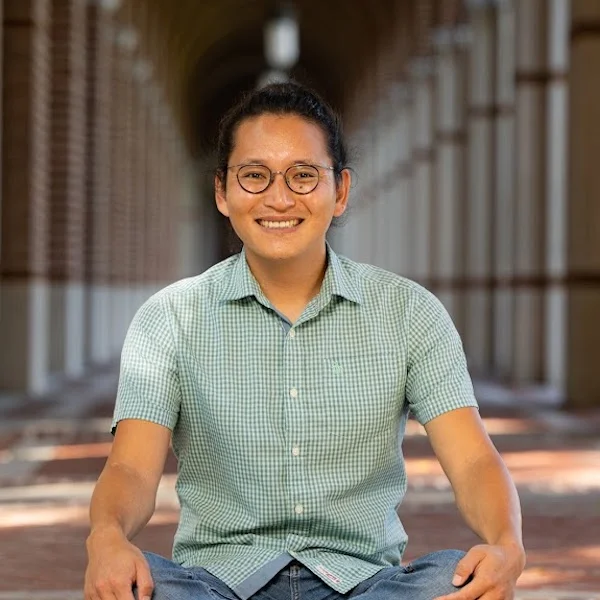
Jaymin Kim
Jaymin Kim is T.T. & W.F. Chao Assistant Professor of Transnational Asian Studies at Rice University. Kim’s research employs pan-Asian sources and interdisciplinary methods to examine the Qing empire (1636–1912) in global contexts. His current book manuscript, “Indeterminate Sovereignty and Pluralistic Jurisdictions in Qing Borderlands” analyzes how Qing and four of its tributary states—Chosŏn Korea, Lê Vietnam, Nguyễn Vietnam, and Kokand in today’s Uzbekistan—sought to rule their borderlands by asserting territorial and legal jurisdictions over borderlanders and their activities. His research has also appeared in journals such as Late Imperial China, Saksaha: A Journal of Manchu Studies, and the Journal of Vietnamese Studies. Kim received his M.A. and Ph.D. in History from the University of Michigan and his B.A. in Asian Studies and History from Rice University. Before joining the faculty at Rice, Kim taught at the University of St. Thomas in St. Paul, Minnesota and the Korea Military Academy in Seoul, South Korea.
Loretta Kim
Loretta E. Kim (PhD, Harvard) is associate professor of Global and Area Studies at the University of Hong Kong. Her principal research interests are the early modern history of Northeast Asia, particularly the greater Amur River region, the northeastern and northwestern frontiers of China, and inter-East Asian social and cultural relations. Her recent teaching work includes courses in modern Chinese history, modern Northeast Asian history, ethno-history, and historical method and practice. Since 2011, she has also offered periodic Manchu language courses for undergraduate and graduate students in Hong Kong. Check out her “Meet a Member” profile to learn more about her work with Manchu!
Lars Laamann
Lars Laamann 勞曼 (SOAS University of London) is interested in popular religion, the history of medicine, as well as Manchu social history between 1700 to 1820. The most relevant publications to Manchu Studies are the four volume Critical readings on the Manchus in modern China (1616-2012) (Leiden, 2013) and “Manchu Teacher of the ‘One Hundred Lessons’ – Creator of a Manchu Linguistic Identity,” in Harrison-Hall & Lovell (eds), Creators of Modern China (2023). He teaches Manchu to beginners (with Gregor WEIMAR and LIN Xiao) and to advanced students of Manchu (documentary readings). He is an Honorary Professor at the Qing History Northern Border Regions Institute, Heilongjiang University 黑龍江大學中國清史北方研究院特聘教授, Visiting Professor at the Manchu Studies College, Jilin Normal University 吉林師範大學滿學院客座教授, as well as the editor of the Central Asiatic Journal. Lars can be contacted by e-mail on [email protected]. More information: http://www.soas.ac.uk/staff/staff31290.php.
Carla Nappi
Carla Nappi (PhD, Princeton) is the Andrew W. Mellon Chair in the Department of History at the University of Pittsburgh. She works in the history of China, of science and medicine, and of early modern translation. She is interested in the translation among words, things, and bodies, and she tends to worry about epistemic and textual architecture and the objects that emerge from it. You can also find her hosting New Books in East Asian Studies and co-hosting New Books in Science, Technology, and Society. Visit her websites http://carlanappi.com/ and http://www.history.pitt.edu/people/carla-nappi
Min-su Park
Min-su Park is an Associate Professor of Asian History in the Department of Social Studies Education at Ewha Womans University. His research focuses on Qing imperial formation, the Banner system, and cross-cultural interactions, with a particular emphasis on Manchu-language sources. His current book project, The Manchu Way to Beijing, uses Manchu documents to reexamine early seventeenth-century Qing state-building. His recent publications explore eighteenth-century bannerman identity, education, and Confucianization through a close analysis of the Emu Tanggū Orin Sakda-i Gisun Sarkiyan. He has held visiting appointments at the Harvard-Yenching Institute, the Chinese Academy of Social Sciences, and the Institute of History and Philology at Academia Sinica. Contact: [email protected]
David Porter
David Porter (PhD, Harvard) is Assistant Professor in the Department of East Asian Studies at McGill University. He is the author of Slaves of the Emperor: Service, Privilege, and Status in the Qing Eight Banners, which seeks to understand the social and political position of the Qing banner system in terms of hereditary legal status and reconceptualize banner people as a multiethnic “service elite.” His current work focuses on bithesi – translators and multilingual clerks in the lower levels of the Qing bureaucracy – as a window into the role of translation in both the Qing state and the lives and career paths of Qing bannermen. Personal website: https://www.davidcporter.com/
Nora Qiu
Dr. Nora Yitong Qiu is a historian of modern East Asia whose work examines how states and empires governed through the material organization of everyday life. She holds a permanent position as Lecturer/Assistant Professor in Modern East Asian History at University College London (UCL), where she directs the Centre for Central and East Asian Studies. She is an Associate Faculty at University of Oxford, Department of History. Her scholarship treats governance as a historical relation between institutional ambition and the material world they sought to order, spanning Qing material culture, imperial medicine, legal pluralism, borderland administration, household accounts, and financial networks. She works across twelve languages, with particular focus on Manchu, Mongolian, and Tibetan primary sources alongside Chinese, Japanese, and European archival materials. In addition to undergraduate and master’s teaching and PhD supervision, she teaches two levels of Manchu language courses and is writing the first English textbook designed to teach Manchu directly through its own script. She received Ph.D. in Economic History from the London School of Economics (2022). Before joining UCL, she taught at LSE and Oxford. Personal website: norayitongqiu.com
Yuanyuan Qiu 邱源媛
QIU Yuanyuan earned a PhD from Chinese Academy of Social Sciences in 2006. She began to learn and use Manchu from 2003. Her main research fields are the court rites and music of the Qing Dynasty, the Eight Banner system and Bannermen society of North China. Her representative works are The Court Rites and Music during the Early Qing《清前期宫廷礼乐研究》(Social Sciences Academic Press, 2012), “Household Registration Booklets of the Estate Stewards under the Imperial Household Department: Population Registers and Genealogies.”《清代内务府庄头户口册:丁册与家谱》(Survival Strategies of the Family in East Asia, Kyujanggak Institute for Korean Studies, 2012.)
Mårten Söderblom Saarela
Mårten Söderblom Saarela (PhD, Princeton) is Assistant Research Fellow at the Institute of Modern History of Academia Sinica. His research interests include the history of scholarship in the Qing empire (1644–1911). He is the author of a dissertation on lexicography and phonology in China’s long eighteenth century, looking primarily at Manchu dictionaries and Manchu-inspired theoretical treatises on language. View his Personal website here.
Wei-chieh Tsai
Wei-chieh Tsai received his PhD from the Department of Central Eurasian Studies at Indiana University. He is currently an Assistant Professor of History at National Chung Cheng University in Taiwan. His research centers on Eurasian history from the Mongol era to the modern period, with particular emphasis on the historical interactions between Inner Asia and China, as well as broader themes of migration, ethnicity, and empire. His work has appeared in Asia Major, Cheng Kung Journal of Historical Studies, Journal of History and Anthropology, Mongolian Studies, and Taiwan Historical Research. He is also the author of From Marco Polo to George Macartney: The Eurasian World since the Thirteenth Century (2025), a collection of essays in simplified Chinese originally published in mass media outlets.
Yulian Wu
Yulian Wu received her BA and MA from the Department of Chinese Literature and Language in Nanjing University, China, and earned her PhD from the History Department at University of California, Davis in 2012. She is a an assistant professor at the History Department of Michigan State University. Her dissertation adopts the perspective from scholarship on material culture to study Huizhou salt merchants in 18th-century China. Her current project studies the production and consumption of jade objects during the High Qing era. As a gender historian, Yulian also studies widow chastity cult, women’s writing, and masculinity in the Qing dynasty.
Huanxi Zhao 赵寰熹
Huanxi Zhao is an Assistant Professor at the College of Resource Environment and Tourism, Capital Normal University, Beijing, China. She received her Ph.D. in Historical Geography from Peking University. Her research interests include Historical geography, Beijing Studies, and Manchu studies. She has published a number of articles including “On the Influence of Ethnic Language on the Research into Historical Culture and Geographical Names” and “Discussion on the Affair and Effect of the Migration of Banner People from the Inner City in Kangxi Period”, Journal of Chinese Historical Geography.”